Reece Prescod on his decision to retire from athletics

After choosing to retire earlier this year, the former British 100m champion reflects on his decision to stop competing at 29.
During the summer, Reece Prescod announced his retirement from international athletics after more than a decade in the sport - a career that saw him reach the biggest stage, including a spot in the 100m final at the 2017 World Championships in London.
It was a quiet decision made early in the year, shared publicly months later. While many were surprised, with Prescod still only 29, the former British champion had already begun looking ahead to what might come next.
“I think I got to the end of last season and obviously, I didn’t make the [Olympic] team,” he says. “In my last couple of races, I just found myself struggling a little bit.”
Rather than pushing through for another cycle, he paused and that break brought clarity.

“I didn’t spend the summer reflecting. I did start training a little bit for a while down in London. But for me, it was about looking at the whole cycle and thinking it’s another big four years to dedicate again at the age I’m at now.”
Prescod’s retirement wasn’t marked by a big send-off or a farewell race. In fact, by the time the announcement was made, the decision had long since been made in private.
“I actually retired back in February, near my birthday,” he says. “My close friends and family obviously knew, but I gave myself a lot of time to figure out what I wanted to do next.
“A lot of the things that I wanted to achieve, I’d already done,” he says. “There were only a handful of goals left. I think I would have had to put a lot in to get close to those. But I said to myself, if I applied the same amount of energy into the new passions and things I’ve developed, where would I be in four years?
“With athletics, you need a really good support system, you need a structure and you need a really good sponsor to be able to see the vision. I didn’t have the support I needed to move forward.”

When the news became public, the reaction was mixed.
“Some people were surprised. Some people were shocked,” he says. “I’m 29, most athletes retire mid or late thirties, so people were like, ‘You’ve got a lot of talent to give.’”
But in private, the response was different, and telling.
“There were a few athletes that reached out and were like, ‘Well, actually I’m maybe considering this myself also.’ Which was kind of interesting.
“Sometimes as an athlete, you’re a bit of a conveyor belt. When’s the next champs? When’s the next team? You just don’t stop. People tend to forget what you’ve done.”
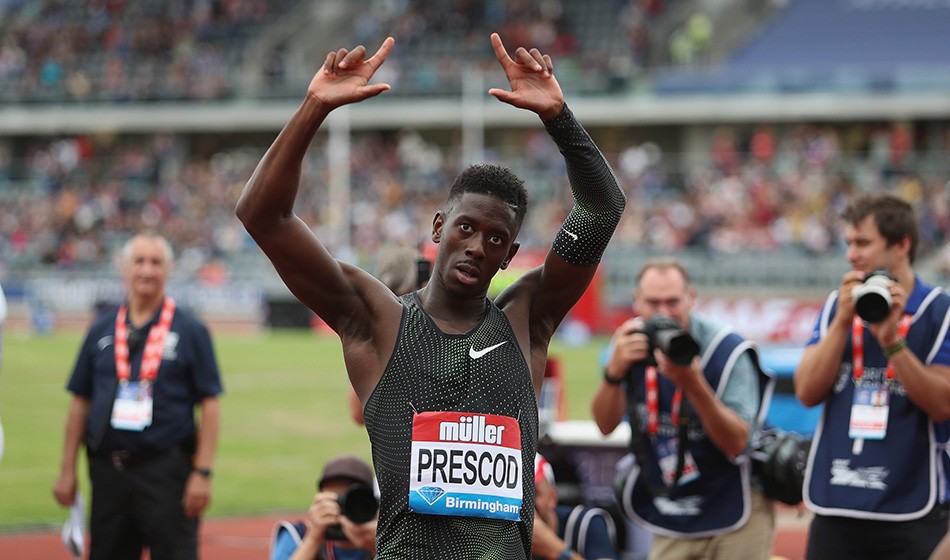
Prescod doesn’t see his career as “unfinished” - just completed on his own terms.
Over the course of a 15-year career, he reached World finals and Olympic semi-finals, ran a personal best of 9.93, and was part of one of the strongest eras of British sprinting.
“I ran sub-10 before the super spikes were around. So I’m happy that I got that in there.”
Though Prescod has stepped away, he remains closely connected to the sport and optimistic about where British sprinting is heading. He points to the current generation of sprinters as evidence of how deep the talent pool now runs, even if the path to consistency remains tough.
“We’ve seen Zharnel [Hughes] as someone that’s been talented over the years,” he says. “One year he might be starting to find form, the next year he breaks the British record and is amazing.”

Prescod also highlights Louie Hinchliffe as one of the breakthrough names of the last year, as well as Jeremiah Azu.
“Someone like Jeremiah - starved for talent, got injured as a junior, went to Italy, smashed it, got a 9.9 last season, then kind of figured it out. And now this year he’s running again.
“That’s part of sprinting. There’s always ups and down’s. Louis has had an amazing breakthrough, it’s just about getting used to a new setup, but again, still has great potential. Eugene [Amo-Dadzie] started late and developed. Romell [Glave] - upcoming talent, took a little while, then got the medal at the Europeans. That’s just athletics.”
Prescod's perspective is shaped by experience. He understands how fine the margins are, and how long it can take to find and then hold top form.

“As a sprinter you go from running 10.7 to 10.3, that’s a big gap. Then 10.3 to 10.1. Then sub-10. But to maintain that? As we’ve seen, it takes years to actually be able to get that in the system.
“That’s part of sprinting. It’s the same across all the events. Athletics is hard. And if you’ve not got the emotional support outside of it, it can be quite challenging and daunting at times.
“I was always focused on the things that I didn’t achieve. Because I had such high performance targets for me that anything that I did didn’t always seem good enough. But in any other sport, it would actually be deemed as good.”
“In tennis or golf, you’re top 20 in the world? You’re a great player. But in athletics, if you finish 13th or 12th in the world, it’s like: ‘That’s not good enough'."

Now, Prescod is redirecting that same competitive drive into coaching and grassroots development. He’s already qualified as a coach with England Athletics and has launched Speed for Sport England, his own sprint programme.
“Every day is about me giving back in a different way, helping people get in shape and introducing them to fitness. But also helping young athletes get faster.
“Before it was about becoming the best athlete. Now, it’s about becoming the best coach.
“To become the best coach, you need education. You need experience. You need to spend hours doing what you do.
“I feel like I’ve started an Olympic cycle - just in a different space now. Over four years, it’s about how I can grow the business, inspire more children, and still be involved in athletics.”